You are viewing an archived auction. Click here to view the current one.
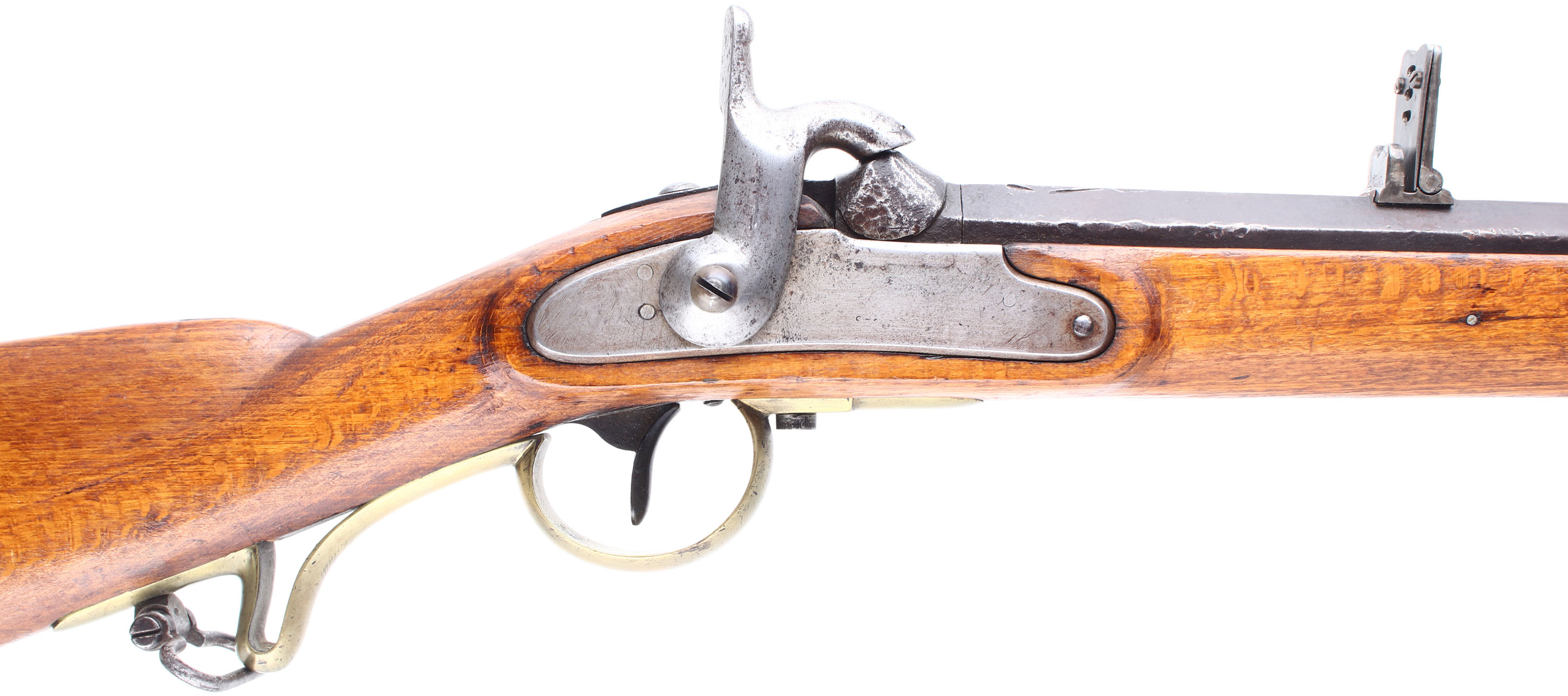
| Austrian, Muster 1849 Kammerbuchse ''Garibaldi'', Percussion...
|
|
Item # 4426 |
|
Guns
|
|
This
lot has ended.
|
| Item Price: |
$525
(excludes shipping)
|
| |
|
Winner will be contacted shortly by Ward's Auctions
|
|
|


|
| Winning Bid
|
US $525 |
|
First bid
|
$500 |
| Quantity |
1 |
|
# of bids |
2
|
| Time left |
Auction has ended
|
|
|
| Started |
2025-07-28 00:00:00 |
|
|
| Ended |
2025-11-21 22:35:25 |
|
|
|
|
|
![]() |
|
|
|
|
|
| Seller assumes all responsibility for listing
this item. You should contact the seller to resolve any questions before bidding.
Auction currency is U.S. dollars (US $) unless otherwise noted. |
Austrian, Muster 1849 Kammerbuchse ''Garibaldi'', Percussion Converted, Cal: .71, MFG: 1849-54, S/N: None, Percussion Rifles Musket, 32 1/8'' barrel.
HISTORY: This rifle is the updated version of the 1844 Kammerbuchse, The brass barrel bands were replaced by a simpler steel band, & a brass semi-pistol grip was added, the bayonet was also updated with a locking ring. These are called ''Kammerbuchse'' (Chamber rifle) because there is a chamber breech stopping the bullet from touching the powder. This was done because Austria was using ''Schiessbaumwolle'' (Shooting cotton) (Gun Cotton) powder in their guns. Gun cotton was a early advancement in gun powder & is The crudest form of nitrocellulose powder (which we call single base powder today). It was discovered in the mid-1840s by Schoenbein, a Swiss-German chemist. Most of the European nations would test Cotton powder for their military around this time, but around the 1850s everyone (but the Austrians) would abandoned it & kept using black powder because Cotton powder was several time more powerful than black powder & if compressed into a gun chamber it burned too rapidly & at too high of a pressure for the guns of the time & would blow up. a Austrian Artillery officer, General Wilhelm Lenk Von Wolfsberg would convince Emperor Franz Josef to continue experimenting with guncotton as he saw the potential of it. Guncotton like smokeless make virtually no smoke or gunpowder residue when fired, a massive improvement from messy black powder. After years of experimenting Von Lenk discovered that weaving the powder into long strips instead of compressing it, it slowed down the burning of the powder so that it could be used without bursting barrels. It was experimented in both small arms & artillery pieces. Von Lenk would later design a cartridge with Guncotton for the model 1854 Lorenz Muzzleloader which used a stick to stop the powder from being compressed by the bullet when seating, rather than a special chamber. Experimentation was going good until July 1862 when a magazine full of guncotton exploded outside Vienna & the cause being from the powder combusting from manufacturing defects. Another explosion of a Guncotton factory in 1865 sealed the fate of guncotton in Austria & they would stop all experimenting with it, never being formally adopted. The earlier rifles like 1844, or the 1849 Kammerbuchse had the special chamber when they were made just in case of future adoption of cotton powder but still used black powder. These rifles were issued to the first two ranks in Jager Battalions, the third rank in Grenz Regiments & other special units who could make use of a shorter rifled musket. These were highly trained skirmishing units who made better use of slower firing but more accurate rifled muskets, rather than the smoothbore musket the standard line infantry used. They were also issued with a large sword bayonet & not the usual spike bayonet. These rifles originally had a ''Tube-Lock'', it used a semi-enclosed flash pan & tube for more reliable ignition, however in the later 1854 Lorez they switched to a less complex percussion action. Many of the older muskets that used the Tube-lock would be converted to percussion in Austria by cutting a part of the breech out & replacing it with a new breech with a percussion nipple. these are also seen with the Belgium cone style by just brazing a nipple to the top of the barrel, these were done in Liege Belgium to rifles that weren't converted by the Austrians when they were sold to the US during the civil war. Around 20,000 of these would be bought & used in the US during the civil war on both the Union & Confederate side (mostly on the Union).
CONDITION: The cheeked straight wrist wood stock is very good as being lightly sanded & re-finished. Buttplate is proud to the wood around the corners of the heel, at the toe, & the barrel tang. Some small dings & one small chip in the wood edges of the ramrod channel. The metal has toned to a mix of gun-metal gray & brown patina, with roughness near the action & ding/tool marks dotted across the entire rifle. The hammer has rust/pitting wear & holes in the percussion cup. The barrel band & around the barrel at the barrel band, has remains of a black paint/ lacquer in protected spots. The top of the barrel is marked ''FS'' over ''51''. The lock plate has very faint remains of the MFG date. The brass semi-pistol grip marked ''56'' & with a worn proof mark. The bore is good to fair. Has strong visible rifling with roughness & light pitting throughout. The barrel holds a worn-down blade front sight with a fixed notch & flip-up ladder V-notch rear sight. The stock carries a brass buttplate, has some small dings & roughness with light patina scattered around. The rifle has both bottom sling loops, the front loops are commonly lost. Rifle has the correct unique ramrod & comes with the correct M1849 Sword socket bayonet. Mechanical function appears solid, soft but audible clicks into the half & full-cocked position. A unique & Rare Civil war imported rifled musket that has interesting developments in weapon technology. Antique/Muzzleloader, No FFL Req - Value: 1000 to 3000
(Move around the image by clicking and dragging. Zoom with your scroll wheel)
| See Payment Instructions
and item description, or contact seller for more information. |
|
|
See item description or
contact seller for more information.
|
|
|
|
| |
How to Pay
If you would like to expedite your payment, please send us an email or give us a call informing us that you would like your invoice emailed to you.
If we do not hear from you one of two things will happen:
A.) If you signed up and asked us to bill your credit card & ship all items ASAP then that is what we will do. No further notice will be sent.
B.) If you signed up and wanted to send us a check, then your invoice will be mailed to you after we figure the shipping. (Please note: If you want to speed this up just send us an email after the auction)
|
|
| |
|
|