You are viewing an archived auction. Click here to view the current one.
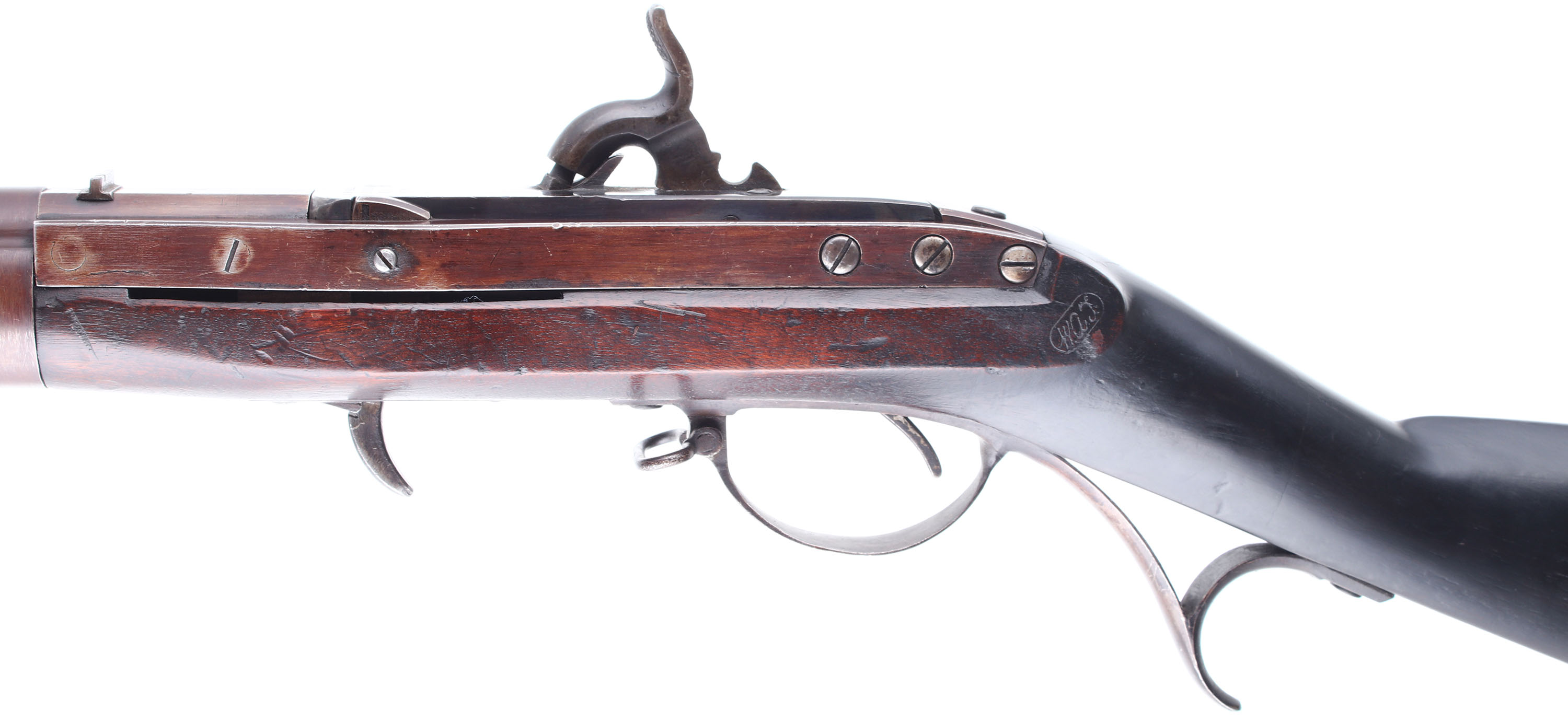
| Harpers Ferry, Model: M1819 Hall Rifle, Percussion converted, Ca...
|
|
Item # 4428 |
|
Guns
|
|
This
lot has ended.
|
| Item Price: |
$1500
(excludes shipping)
|
| |
|
Winner will be contacted shortly by Ward's Auctions
|
|
|


|
| Winning Bid
|
US $1500 |
|
First bid
|
$1500 |
| Quantity |
1 |
|
# of bids |
1
|
| Time left |
Auction has ended
|
|
|
| Started |
2025-07-28 00:00:00 |
|
|
| Ended |
2025-11-21 22:35:25 |
|
|
|
|
|
![]() |
|
|
|
|
|
| Seller assumes all responsibility for listing
this item. You should contact the seller to resolve any questions before bidding.
Auction currency is U.S. dollars (US $) unless otherwise noted. |
Harpers Ferry, Model: M1819 Hall Rifle, Percussion converted, Cal: .52, MFG: 1832, S/N: None, Percussion converted breech loader, 32 3/4'' barrel.
HISTORY: Designed by John Hancock Hall. The Hall rifle was the first breech-loading rifle to be adopted in large numbers by any nation's army. Instead of having to load from the muzzle, the chamber can pivot up & you can load your ball & powder from there. This made reloading faster in general & since you did push the bullet through rifling to load, being rifled or smooth bore did not affect reloading speed. The army conducted tests & found it was more accurate than their rifles & reloaded faster than the smoothbores. Carbines were produced starting in 1833, these had smooth bore barrels & were the first Percussion arm adopted by the US. New rifles would be produced with the percussion lock & older rifles would be retrofitted. The rifles would see updates through the years until production stopped in 1844. These were used in US conflicts up till the civil war, basically they were used until they wore out. Some were sold to Argentina when the US started replacing them with sharps & The Buenos Aires State Forces would use them in small numbers clear until 1881. Thousands of rifles were made, though the troops and many leaders preferred the simplicity and lower costs of muzzle-loaded weapons, but the advantages were clear, & its influence paved the way to new breech loading designs. John Hall built his own shop (Hall rifle works) & machines at Virginius Island on the Shenandoah River, just around the corner from Harpers Ferry located on the Potomac River. He built the rifles with the brand-new concept of interchangeable parts & would pioneer the concept for the whole world. Hall was able to start producing the rifles at his factory starting in 1824 & would receive a contract for 1,000 rifles. He would quickly get another contract for 1000 as the rifles from the other order were being delivered. The need for the rifles would soon outgrow Halls factory & Simeon Noeth of Middletown CT would get a contract for Hall rifles, but the parts had to be completely interchangeable with the Harpers Ferry guns. He was able to achieve this & started making rifles in 1830. North would end production with Hall carbines in 1853. This was the first time in history that rifles from two different manufacturers had completely interchangeable parts. between the two manufactures about 50,000 hall rifles & carbines were produced.
CONDITION: The straight wrist walnut stock is very good near excellent with some minor nicks, dings, & dents. Stock has darkened from added oils & age. The top of the wrist has a arsenal repair where the stock split from incorrect disassembly technique (common problem with the rifle). The left side of the stock by the rear of the receiver is stamped ''WAT'' in box, these are the initials of inspector William Anderson Thorton, he was the commander of the New York Arsenal & later the Water town arsenal from 1841-66, he oversaw the factory when it was converted to percussion. The metal was re-finished when it was converted. The case-hardened finish on the breech block rates 90% with wear around the nipple & at the top from closing the breech. The browning finish on the barrel & receiver rates 87% with spots of thinning & scratches. The top of the breech block is marked ''J. H. HALL'', ''H FERRY'', ''US'', ''1832''. The inside of the buttplate is marked ''IX P'' this is the first style conversion mark. The bore is excellent. It's bright & shiny with strong rifling but it does has a couple spots of light roughness nearing the end of the muzzle. The bore is smooth the last 1'', this was done to help load from the muzzle in a emergency if the breech could not be opened. The barrel holds a square blade sight with a fixed V-notch rear sight. Rifle has both bottom sling loops & the ramrod. A Beautiful example of a Arsenal re-finished Hall Rifle Antique, No FFL Req. - Value: 3000 to 6000
(Move around the image by clicking and dragging. Zoom with your scroll wheel)
| See Payment Instructions
and item description, or contact seller for more information. |
|
|
See item description or
contact seller for more information.
|
|
|
|
| |
How to Pay
If you would like to expedite your payment, please send us an email or give us a call informing us that you would like your invoice emailed to you.
If we do not hear from you one of two things will happen:
A.) If you signed up and asked us to bill your credit card & ship all items ASAP then that is what we will do. No further notice will be sent.
B.) If you signed up and wanted to send us a check, then your invoice will be mailed to you after we figure the shipping. (Please note: If you want to speed this up just send us an email after the auction)
|
|
| |
|
|